In the manufacturing industry, choosing the right welding process is crucial. It directly affects product quality and production efficiency. Spin welding and ultrasonic welding are two popular methods, each offering unique advantages. Understanding how to choose between spin welding and ultrasonic welding is vital for optimal outcomes.
According to a report by Smithers Pira, the global market for plastic welding technologies reached $2.3 billion in 2022, with significant growth projected. Companies need to consider the materials and applications involved. Spin welding is often preferred for larger parts with simple geometries, while ultrasonic welding excels in precision applications. Each method has its own learning curve and deep expertise is required to master these technologies.
However, many manufacturers underestimate the complexities of each process. The decision can impact not only production rates but also long-term reliability. It’s essential to weigh factors like cycle time and energy consumption. With evolving technologies, staying informed is key to making the right choice. Manufacturers must reflect on their specific needs and challenges to determine the most effective welding method.
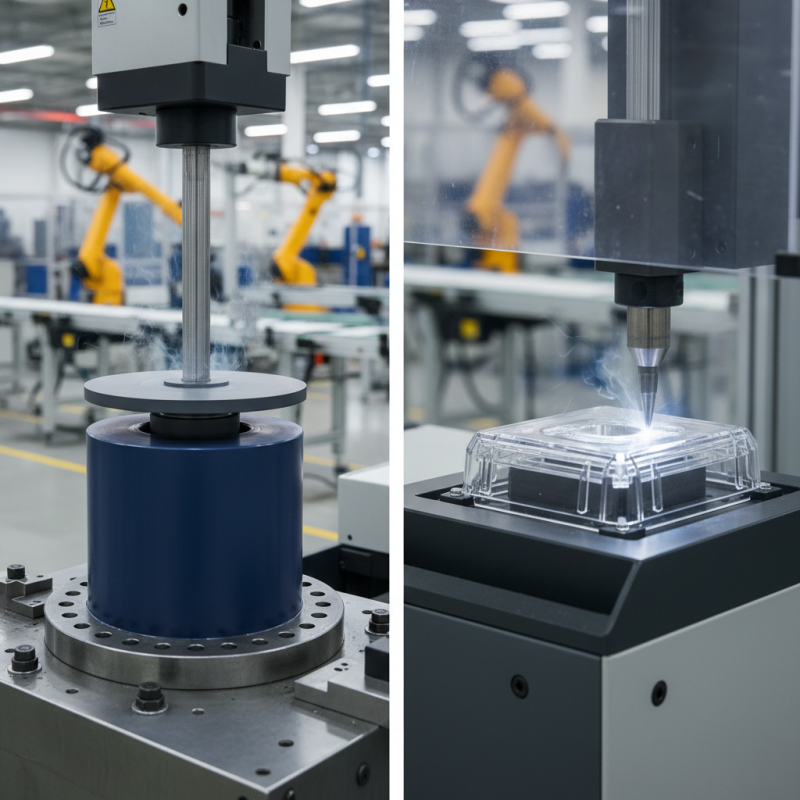
When choosing between spin welding and ultrasonic welding, several key factors come into play. One of the most significant aspects is the material being joined. Spin welding excels with thermoplastics, as the generated heat can effectively create strong bonds. In contrast, ultrasonic welding is more versatile, working well with a variety of materials, including thin films and delicate components.
The size and shape of the parts being welded also matter. Spin welding is typically best suited for larger, disk-shaped components. However, for smaller or irregularly shaped items, ultrasonic welding might be the optimal choice. Additionally, consider the production volume. Spin welding can be faster for large batches, while ultrasonic welding may be more beneficial for smaller quantities needing precision.
It's essential to reflect on the application's requirements. Will the weld need to withstand extreme conditions? What are the aesthetic considerations for the finished product? These questions can guide the decision-making process. Each method has its strengths and weaknesses, prompting the need for thorough evaluation. Testing both processes on your specific parts could yield surprising insights, helping to ensure you choose the most effective welding method for your needs.
Spin welding is a versatile joining technique widely used in various industries. This process utilizes friction to generate heat, allowing two plastic parts to be fused seamlessly. The machine rotates one component at high speeds while applying pressure to the other. This method is particularly effective for thermoplastics, making it suitable for creating durable, strong bonds. The simplicity of spin welding equipment also appeals to manufacturers, as it often requires less maintenance compared to other welding processes.
Applications of spin welding span across multiple sectors, including automotive, electronics, and consumer goods. For example, it's frequently used to assemble components in fuel tanks or medical devices. The efficiency of this technique contributes to reduced production time, which benefits manufacturers striving for quick turnarounds. However, not every situation may work well with spin welding. Factors such as part geometry, material type, and required strength can complicate the process. It's imperative to assess these variables thoroughly before choosing spin welding as a viable solution. This reflection highlights the necessity of understanding the specific requirements of each project to achieve optimal results.
Ultrasonic welding is a popular method for joining thermoplastics and metal parts. It utilizes high-frequency ultrasonic vibrations to create a solid-state weld. The process requires minimal energy, making it efficient. According to a report by Research and Markets, the ultrasonic welding market is expected to reach $2 billion by 2026, reflecting its growing relevance in various industries.
This technology is particularly effective in the automotive and medical sectors. In automotive manufacturing, ultrasonic welding is used for components like electronic assemblies and dashboard parts. It ensures strong bonds without the need for adhesives. In the medical field, it is commonly employed to seal sterile packaging. This process ensures that products remain uncontaminated. However, the complexity of the equipment can pose challenges. Maintenance and operator training are crucial for optimal performance.
Reliability is a key advantage of ultrasonic welding. The process produces consistent results with minimal defects. However, factors like material compatibility and joint design can influence weld quality. Engineers must carefully evaluate these elements to avoid poor bonding. Awareness of limitations is essential for successful application.
When considering spin welding and ultrasonic welding, it's essential to evaluate their unique characteristics. Spin welding involves rotating one part against another, generating friction and heat to create a solid bond. This method is particularly effective for assembling parts made of thermoplastics. It can handle various shapes and sizes, making it versatile for different applications. However, precision is crucial. Misalignment during the process may lead to weak joints or part failure.
On the other hand, ultrasonic welding uses high-frequency vibrations to create heat at the interface of materials. This technique is primarily used for smaller components and provides excellent control over the welding parameters. The speed of ultrasonic welding is impressive, but it may not be suitable for thicker materials. Both methods offer distinct advantages, yet they also come with limitations. Choosing between them requires careful analysis of the specific project requirements.
Cost considerations, energy efficiency, and required equipment also play significant roles in the decision-making process. If a project has standards that demand robustness, spin welding may be preferable. In contrast, for intricate designs needing rapid assembly, ultrasonic welding could be the superior choice. Each method's effectiveness largely depends on understanding the application.
When choosing between spin welding and ultrasonic welding, cost efficiency and quality are crucial factors. Spin welding often requires less initial investment. It can be more suitable for high-volume production. However, it may compromise on the precision of welds. Ultrasonic welding, on the other hand, provides strong, high-quality bonds. This method often results in more consistent performance. The cost may be higher, but the reliability can reduce rework costs.
Quality considerations play a significant role in these decisions. Spin welding can produce visually appealing welds. Yet, the strength might vary depending on the material used. Ultrasonic welding excels in producing uniform joints that can withstand greater stress. This method is particularly advantageous for complex designs. It offers better control over energy input, which improves overall performance. Reflecting on the specific application is vital for both methods. Evaluating production needs and long-term goals can lead to better choices.
: Spin welding rotates one part against another to create friction and heat, forming a solid bond.
It handles various shapes and sizes and is effective for thermoplastics in high-volume production.
Precision is crucial. Misalignment can lead to weak joints or part failure, which is a concern.
Ultrasonic welding uses high-frequency vibrations to generate heat at the materials' interface, fusing them together.
This method is ideal for smaller components and intricate designs needing fast assembly and strong bonds.
Spin welding often requires a lower initial investment, while ultrasonic welding may have higher upfront costs.
Ultrasonic welding generally provides stronger, more consistent welds, while spin welding may have variable strength.
For projects needing robustness in high-volume production, spin welding could be the better choice.
Reflect on production needs, cost efficiency, and quality requirements to determine which method fits best.
No, each method has unique advantages and limitations; it depends on specific project requirements.
In the decision-making process of "how to choose between spin welding and ultrasonic welding," several key factors should be taken into account. Understanding the specific requirements of your project is essential; factors such as materials, part geometries, and production volume can influence the choice. Spin welding is often favored for larger, more robust applications, while ultrasonic welding is ideal for finer, more intricate components.
Moreover, each welding technology has its own set of applications and advantages. A comparative analysis reveals that spin welding is efficient for joining thermoplastics through rotational motion, offering strong bonds for larger assemblies. Ultrasonic welding, on the other hand, utilizes high-frequency vibrations to produce quick, clean welds without significant heating, making it suitable for delicate materials. Cost efficiency and quality considerations also play critical roles in determining the appropriate method, alongside the anticipated production rates and overall project goals.

Heping Mechanical